
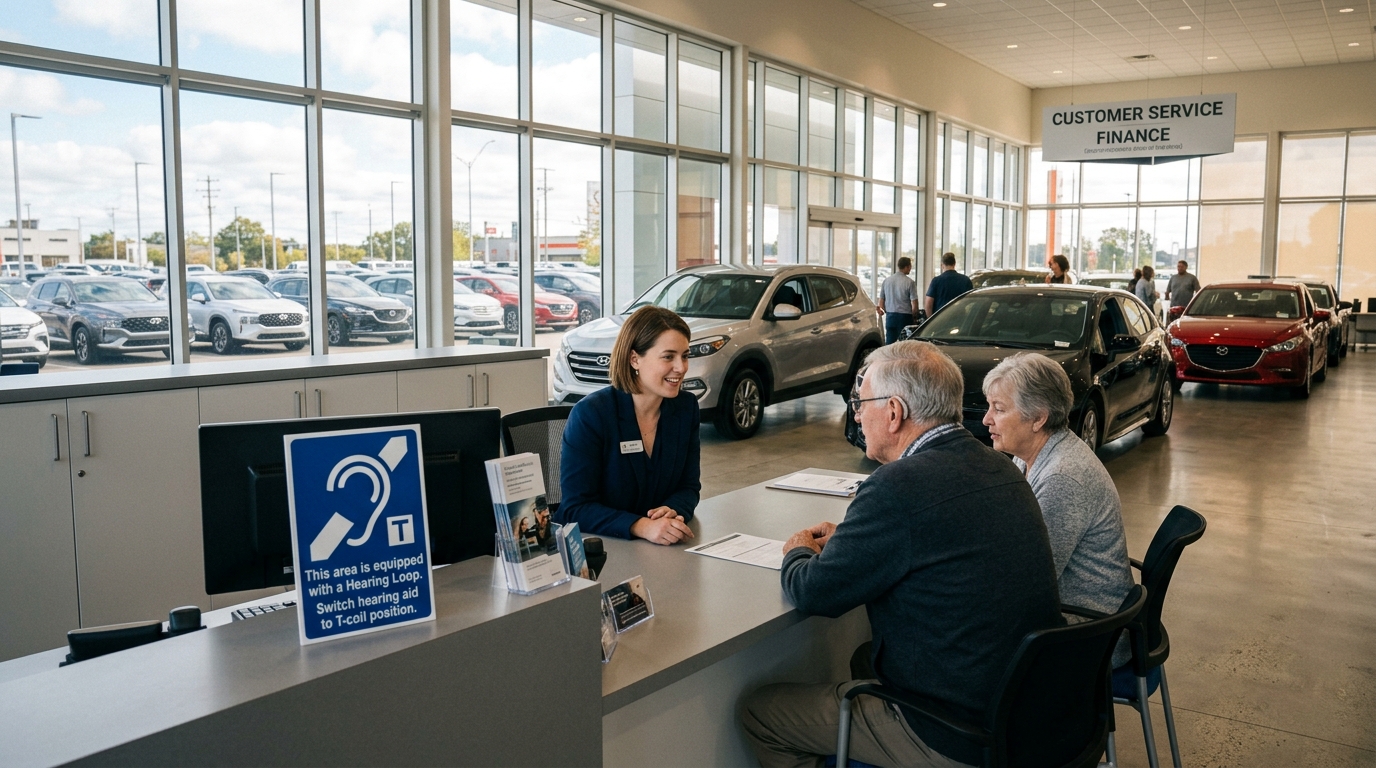
Buying a car is already one of the bigger decisions most people make in their lifetime. You are talking about money, trust, long conversations, and sometimes hours spent going back and forth over financing numbers. Now imagine doing all of that while struggling to hear the salesperson clearly because of background noise, poor acoustics, or a hearing condition that makes every muffled word feel like a guessing game. For millions of people across the United States, that is not a hypothetical — it is the reality every time they walk into a dealership.
This is exactly where a car dealership with hearing loop technology changes everything. A hearing loop, also known as an induction loop system, sends sound directly into hearing aids or cochlear implants through a telecoil setting. Instead of fighting against background noise, you receive clear speech right where you need it — in your ear. No shouting, no repeating, no frustration.
In this guide, we are going beyond the basics. Most articles on this topic explain what a hearing loop is and stop there. Here, we are covering how to actually find and verify one, what types exist, what your legal rights are, what to do if it fails during your visit, and why some dealerships are still falling short even after calling themselves ADA-compliant. Whether you are a hearing aid user, a caregiver, a veteran, or simply someone who values inclusive customer service — this article is written for you.
What Exactly Is a Car Dealership With Hearing Loop and How Does It Work?
A car dealership with hearing loop support is one that has installed an assistive listening system inside its showroom, finance office, reception area, or service counter — or ideally all of the above. The technology itself is built around a simple but powerful concept: instead of amplifying sound in the room (which also amplifies background noise), it sends a magnetic signal directly to the telecoil inside a compatible hearing aid or cochlear implant.
The main components of a hearing loop system include a microphone that picks up the speaker’s voice, an amplifier that processes and strengthens that audio signal, and a loop wire that runs around the perimeter of a room or under a counter. When a staff member speaks, that voice travels electromagnetically to the listener’s hearing device with dramatically improved clarity and almost zero background interference.
For customers who use hearing aids with a telecoil — often called a T-coil or T-setting — the experience is immediate and natural. You switch your hearing aid to T-mode, and suddenly conversations that were blurry and stressful become crisp and manageable. This is not a workaround. It is a proper, internationally recognized assistive technology standard used in airports, theaters, banks, and increasingly in retail customer service spaces like car dealerships.
The Real Reason Hearing Loss Makes Car Buying So Stressful (And How Hearing Loops Fix It)
There is a reason people with hearing difficulties often dread large retail environments. Dealership showrooms are acoustically terrible spaces. High ceilings, hard floors, glass walls, and open layouts create constant echo. Multiple conversations happen simultaneously. Music plays in the background. Service bays generate mechanical noise. And in the middle of all this, a finance manager is explaining your interest rate, your monthly payment, and the fine print on your warranty.
Missing a single word in that conversation is not just inconvenient — it can be costly. A person who mishears a loan term, misunderstands a trade-in offer, or nods along without actually catching the service plan details is at a real disadvantage. This is not about intelligence or effort. It is about physics. Sound behaves differently for people with hearing impairments, and a noisy showroom is genuinely one of the worst environments for clear communication.
A hearing loop addresses this at the source. By delivering clean audio directly through telecoil technology, it removes background noise from the equation entirely. Customers stop spending mental energy trying to decode speech and start actually absorbing information. That shift — from stressful guesswork to confident understanding — is the real value of finding a car dealership with hearing loop infrastructure in place.
Which Areas Inside a Dealership Need a Hearing Loop the Most?
Not all areas of a dealership carry the same communication weight. Some spaces involve casual browsing where missing a word is no big deal. Others involve detailed, high-stakes conversations where clarity is essential. Here is a breakdown of where hearing loop coverage matters most and why:
Finance Office: This is the most critical room in any dealership for hearing accessibility. Customers here are reviewing contracts, discussing interest rates, choosing add-ons, and signing legally binding documents. A hearing loop in the finance office means customers can process every number, every clause, and every option with full confidence.
Reception and Check-In Desk: First impressions matter. When a hearing-impaired customer walks in and is immediately able to communicate comfortably at the front desk, it sets a positive tone for the entire visit. Counter loops — small loops installed directly under or around a service counter — are commonly used here.
Showroom Floor: While the showroom tends to be the noisiest area, it is also where most initial product conversations happen. Hearing loops in the showroom help customers engage with sales representatives without constantly asking for repetition.
Service Waiting Area: Customers returning for maintenance or repairs often wait while staff explain what was found during inspection. Understanding those updates clearly affects decision-making about repairs, costs, and timelines.
Private Consultation Rooms: Some dealerships have dedicated rooms for negotiations or finance discussions. These are ideal for hearing loop installation because they are smaller, quieter, and easier to wire effectively.
How to Verify If a Car Dealership With Hearing Loop Is Actually Functional Before You Visit
Here is something most articles skip entirely: just because a dealership says it has a hearing loop does not mean that loop is actually working. Systems go untested for months. Staff rotate and nobody learns how to switch the equipment on. The loop wire in the floor develops a fault and nobody notices. You deserve better than showing up to discover the system has been broken since last year.
Before you visit any dealership claiming to have a hearing loop, take these steps to protect your time and your experience:
- Call ahead and ask specifically: ‘Is your hearing loop currently active and tested?’ A vague answer like ‘we have one somewhere’ is a red flag.
- Ask which areas of the dealership are covered — showroom only, finance office, reception desk, or all areas?
- Request that a staff member test the equipment before your appointment and confirm it is functioning.
- Look for the international hearing loop symbol at the entrance — a stylized ear with the letter T inside it. Its absence does not always mean no system exists, but its presence is a positive indicator.
- Ask if staff are trained to assist hearing-impaired customers, or if there is a designated accessibility contact.
- Check online reviews. Many hearing aid users specifically mention accessibility experiences in their dealership reviews — search the dealership name alongside terms like ‘hearing loop’ or ‘hearing aid’ in Google reviews.
This verification step takes five minutes by phone and can save you significant frustration on the day of your visit.
Hearing Loop vs Other Assistive Options at Dealerships — Which One Actually Works Better?
Some dealerships that have not invested in hearing loop systems offer alternative accessibility tools instead. It is worth understanding how these compare so you can make an informed decision about which environment will actually work for you.
| Option | Background Noise Reduction | Hearing Aid Direct Support | Private Listening | Ease of Use |
| Hearing Loop | Excellent | Yes via telecoil | Yes | Automatic with T-coil |
| Portable FM System | Moderate | Requires receiver device | Partial | Needs setup each time |
| Captioned Phones | None | No | No | Text-based only |
| Written Notes | None | No | No | Slow, incomplete |
| Staff Speaking Louder | None | No | No | Can distort speech |
| Video Relay Service | Good | No | Yes | Requires interpreter |
As the comparison shows, a hearing loop is the only option that works automatically with your existing hearing aid, requires no additional equipment, provides private listening, and actively reduces background noise. Speaking louder — which many well-meaning staff members attempt — actually makes the problem worse by distorting speech frequencies and drawing attention in a public space. A proper induction loop system is simply the best available solution for in-person dealership communication.
Who Benefits Most From a Car Dealership With Hearing Loop Support?
The obvious answer is hearing aid users and people with hearing loss. But the reality is broader than that, and dealerships that understand this tend to invest more meaningfully in accessibility infrastructure.
Older adults: Hearing loss becomes increasingly common after age 60. Since a significant portion of car buyers fall into older age groups, hearing loop technology directly serves a large and loyal customer segment. Older buyers also tend to value careful, clear communication more than any other demographic.
Veterans: Noise-induced hearing loss is one of the most common service-related disabilities among military veterans in the United States. Veterans represent a meaningful share of car buyers, and a dealership that accommodates their communication needs builds lasting loyalty.
Cochlear implant users: People with cochlear implants benefit significantly from telecoil-compatible hearing loops, especially in noisy environments like showrooms.
People with auditory processing disorders: Even some individuals with normal hearing sensitivity struggle to process speech in noisy environments. A hearing loop can help by delivering a cleaner signal.
Caregivers and family members: When someone accompanies a hearing-impaired buyer, the presence of a hearing loop reduces the translator role that caregivers are often forced into during important financial conversations.
Beyond these groups, accessible communication tools benefit everyone in the dealership. Clearer audio systems, quieter consultation rooms, and trained staff create a better experience across the board — not just for customers with hearing difficulties.
ADA Compliance vs Genuine Accessibility — Are Dealerships Doing Enough?
This is a distinction that rarely gets discussed honestly. The Americans with Disabilities Act sets a legal floor for accessibility — not a ceiling. Meeting the minimum ADA requirements for communication accessibility means a dealership must provide effective communication for customers with disabilities. However, the law does not specifically mandate hearing loop installation in every location. What it does require is that businesses provide auxiliary aids and services when needed.
In practice, this means a dealership could technically satisfy ADA requirements by offering written notes or a portable FM system, even if neither works particularly well in a noisy showroom. Many dealerships consider themselves compliant simply because they have not received a formal complaint.
Genuine accessibility is a different standard entirely. It means proactively installing hearing loops in high-traffic communication areas, training staff on how to use them and how to interact respectfully with hearing-impaired customers, displaying the hearing loop symbol prominently, and testing equipment regularly. The gap between ‘legally compliant’ and ‘genuinely accessible’ is where most dealerships currently sit.
If you believe a dealership has failed to provide effective communication accessibility under the ADA, you have the right to file a complaint with the U.S. Department of Justice Civil Rights Division. You can do this online through their ADA complaint portal. This is not a small matter — ADA complaints related to communication accessibility are taken seriously, and businesses can face investigations and required remediation. Knowing your rights before your visit puts you in a stronger position from the start.
How Dealership Staff Training Affects Your Experience as a Hearing-Impaired Customer
Technology is only one part of the equation. A perfectly installed hearing loop system becomes useless if no staff member knows how to turn it on, explain it to a customer, or even recognize that a customer might benefit from it. Staff training is the piece that most dealerships — even those with the right equipment — consistently underinvest in.
What good accessibility training looks like in a dealership context goes beyond a one-hour compliance video. It includes staff understanding how to recognize when a customer may benefit from assistive listening without making that person feel singled out or embarrassed. It includes knowing how to switch on the hearing loop at the finance desk, how to speak clearly without over-exaggerating lip movements, how to maintain eye contact during conversations, and how to confirm that important information has been understood without being condescending.
There is also an emotional dimension here that often gets overlooked. Customers with hearing difficulties frequently describe the experience of being in loud service environments as exhausting and dehumanizing. Staff who take a moment to step into a quieter space, face the customer directly, and speak with patience rather than impatience create a completely different emotional experience. That human element — not just the technology — is what drives repeat business and word-of-mouth referrals from the hearing-impaired community.
When evaluating a car dealership with hearing loop infrastructure, it is worth asking whether staff have received any accessibility awareness training. A dealership that has invested in both the technology and the human side of accessibility is genuinely rare — and genuinely worth supporting.
The Future of Accessible Car Dealerships AI Captions, Smart Loops, and What’s Coming Next
The landscape of hearing accessibility in retail environments is changing quickly, and car dealerships that are paying attention are beginning to integrate next-generation tools alongside traditional hearing loop systems.
Real-time captioning screens are one of the most promising developments. These displays show a live text transcript of what a staff member is saying, allowing customers with hearing difficulties to read along during conversations. Some dealerships in major markets are already piloting these systems at reception desks and in finance offices.
AI-powered speech clarity tools are another emerging category. These systems analyze incoming audio in real time and filter out background noise before it reaches the hearing aid or display screen. Combined with a standard hearing loop infrastructure, they could dramatically improve the experience in high-noise showroom environments.
Mobile accessibility apps are also growing in relevance. Some dealerships are experimenting with tablet or smartphone-based communication tools that allow customers to type questions while staff respond verbally — or vice versa — creating a hybrid communication channel that works for a wide range of hearing needs.
The direction is clear: inclusive communication is moving from a checkbox compliance item to a genuine competitive differentiator. Dealerships that lead this transition early will develop reputations — and customer bases — that are difficult to replicate. A car dealership with hearing loop technology today is simply getting started on a path that the best-performing dealerships will fully embrace within the next few years.
How to Use Online Tools and Directories to Find a Car Dealership With Hearing Loop Near You
Finding a car dealership with hearing loop support in your area is more achievable than many people assume — but it does require knowing where to look, because dealerships rarely lead with accessibility in their advertising.
- Search Google with specific terms: Try ‘car dealership hearing loop [your city]’ or ‘accessible car dealership hearing aid [your state]’. Add terms like ‘telecoil’ or ‘induction loop’ to narrow results further.
- Check the RNID (Royal National Institute for Deaf People) hearing loop directory if you are in the UK, or similar national organizations in your country. In the US, state vocational rehabilitation offices sometimes maintain accessibility business directories.
- Use Google Maps accessibility filters: When viewing a business listing on Google Maps, scroll to the ‘Accessibility’ section. Some dealerships have updated their listings to reflect hearing loop availability.
- Contact your local hearing aid audiologist: Audiologists frequently know which nearby businesses have accessible environments because their patients mention it. They can often give you a short list of verified hearing-friendly dealerships in your area.
- Ask on hearing loss community forums: Organizations like the Hearing Loss Association of America (HLAA) have active online communities where members share specific business recommendations based on real accessibility experiences.
- Call manufacturer dealership networks directly: Large automotive groups like AutoNation, Lithia Motors, and Hendrick Automotive have corporate accessibility coordinators. Contacting their headquarters and asking about hearing loop availability across their network can yield useful, verified information.
One more step worth taking: after you find and visit a dealership with a functioning hearing loop, leave a detailed review mentioning the accessibility features. This helps other hearing-impaired customers find the same business, and it signals to other dealerships in the area that accessibility is something their customers actively notice and value.
Read: Playing Games PlayBattleSquare
Pre-Visit Accessibility Checklist for Hearing-Impaired Car Buyers
Use this checklist before visiting any dealership to ensure your communication needs are met from the moment you walk in:
- Called ahead and confirmed hearing loop is installed and currently functioning
- Asked which specific areas of the dealership have loop coverage
- Requested a quiet consultation room for finance discussions
- Asked whether staff have accessibility awareness training
- Checked for the international hearing loop symbol (ear with letter T) online or at entrance
- Confirmed hearing aid is set to T-coil mode or telecoil setting
- Brought a backup communication method (notepad, phone text, companion)
- Scheduled appointment during off-peak hours for lower ambient noise
- Noted the ADA complaint contact in case accessibility needs are not met
- Read recent reviews mentioning accessibility or hearing experiences
Final Thoughts Choosing a Car Dealership With Hearing Loop Is Choosing Respect
At its core, the decision to find a car dealership with hearing loop technology is not really about the technology at all. It is about choosing an environment where you are not expected to simply manage or get through a conversation — but where the business has actively invested in making sure you can fully participate in one.
The automotive industry is slowly waking up to the reality that accessible communication is not a niche accommodation for a small minority. It is a baseline expectation from a growing segment of the car-buying public. Older adults, veterans, cochlear implant users, and people with auditory processing challenges collectively represent tens of millions of potential customers. Dealerships that treat their needs as an afterthought are leaving real business on the table.
What makes a great car dealership with hearing loop support is not just the wire in the floor or the amplifier in the back room. It is the trained staff member who knows how to turn the system on. It is the finance manager who faces you when speaking and confirms you understood the contract terms. It is the service counter that has a counter loop and a staff member who does not rush the conversation. It is the willingness to test the equipment before your appointment and fix it when it breaks.
You deserve to buy a car with complete confidence — confidence in what you heard, what you agreed to, and what you are driving home in. Insist on that standard. Ask the hard questions before you visit. Use your legal rights if a dealership fails to meet them. And when you find a dealership that genuinely gets it, support them with your business and your review.
Inclusive communication is not a favor. It is a fundamental part of good customer service — and it is exactly what every car dealership with hearing loop technology, properly installed and properly maintained, is designed to deliver.